Breaking the Status Quo: why buyers ‘do nothing’ and what to do about it
Introduction
One of the bigger challenges in taking an offering to market is breaking the status quo in at our prospects. ‘Do nothing’ is often our biggest competitor so understanding why buyers choose not to act is vital, and the first step in being able to influence that choice. We see detemining buying inhibitors as one of three questions we need to answer about our buyers’ purchasing motivation.
- The motive force: What motivates buyers to take action, such as making a purchase or building their own solution? (in Sales shorthand ‘pain/gain’ – pains to be addressed or gains to be realised)
- The work required: What work do buying teams need to undertake to make the purchase? (the buying jobs described by Gartner, which we summarise in The B2B Magnificent Seven)
- The inhibitors: What are the factors that inhibit buyers from taking action? These are what we refer to as the five fearsome forces of the familiar and are the subject of this article.
Why Buyers Do Nothing: What the Research Says
Research dating back to the 1980s shows that the newer a purchase is to the buyer, the more they need to know before deciding.
- Studies of business buying found that a new problem brings more questions, more searching and more checking (Anderson, Chu and Weitz, 1987; Bunn, 1993).
- Psychology explains why these doubts hold buyers back: people keep what they already have when a familiar option exists (Samuelson and Zeckhauser, 1988).
- They feel worse about harm caused by acting than by staying put (Ritov and Baron, 1995). And they avoid choices whose odds they can’t judge (Ellsberg, 1961).
- Familiar suppliers win because they lower the doubt (Chen, Levy, Martin and Shalev, 2021).
The Five Forces
Together, the research describes five forces. Each is something the buyer is unsure of or uneasy about, so it is effectively a psychological burden and distinct from the work of buying. As a result, these forces are not easy to detect.
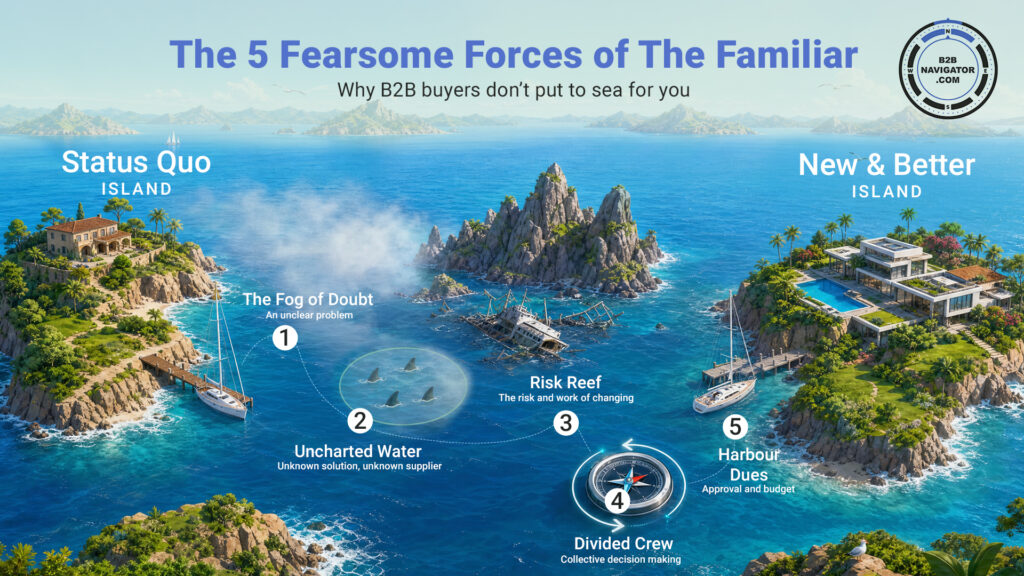
Our graphic represents the five forces of the status quo as a series of hazards. Like the buying process, this is not linear, and forces can overlap and recur during a purchase.
In our graphic, every buyer lives on Status Quo Island. It is familiar, it works well enough, and everyone is flat out running, growing, and changing the business.
Sellers point across the water to the New & Better Island and expect the buyer to sail. Most choose not to. The usual explanation is ‘no decision’, and it is common: a study of 2.5 million recorded sales conversations found that 40% to 60% of deals ended that way, and in more than half of those the buyer wanted to change but could not decide (Dixon and McKenna, 2022).
The motive force of ‘pain and gain’ is the wind that could carry the buyer across, and the five fearsome forces of the familiar are what the wind has to overcome.
The Fog of Doubt
‘Is there even a problem?’ (problem and outcome uncertainty)
A buyer may understand your value proposition and still doubt that the problem deserves their attention. There are numerous causes for this. When the business is doing well enough, the improvement may appear as a ‘nice to have’. Doubt may also result from the belief that an incumbent supplier will probably address this in the future. Others are busy with fires that already have owners, deadlines and budgets, so a possible problem (classified as ‘smoke’) joins the back of the fire-fighting queue. The problem may also fall between departments, making it nobody’s target; and if peers, analysts, and the trade press aren’t talking about it, it doesn’t yet feel like a recognised business risk.
Uncharted Water
‘Will it work? Can we trust them?’ (solution and supplier uncertainty)
Here, the buyer may accept the need but doubt a new method or supplier, or both. A new approach from an unfamiliar company gives the buyer far more to investigate.
Familiarity has a considerable head start. In 6sense’s buyer research into completed purchases, 85% of buyers reported previous experience with the supplier they selected.
The pull of the familiar includes the buyer’s in-house capabilities and incumbent suppliers. With the rise of AI, the ability to build prototypes and POCs rapidly, and for existing vendors to offer new AI-driven features both make it easier to reject new
Risk Reef
‘Is it worth the risk and the work?’ (change and transition burden)
Even with those two obstacles behind them, there is the practical matter of getting the new solution into use. There may be data to move, processes to adjust, or the not inconsiderable task of getting users to adopt it or the security team to sign off on it. Someone must take responsibility for any potential disruption, and for the ultimate success or failure of the implementation.
Some buyers will be candid about this, but many will be reluctant to share this sensitive information. In one meeting about a mission-critical application, the buyer decided our assurances were not enough: ‘That’s really not enough for us to proceed with you. You need to understand it is my neck on the block here.’
Buyer’s fear of failure is a substantial consideration here. This is well documented in JOLT, which is one of the frameworks we use and is also summarised in the The B2B Magnificent Seven.
Divided Crew
‘Can we reach consensus?’ (collective decision burden)
Improving one part of the business can create work for another. Finance may gain a useful new capability while IT inherits the integration and support. Both can be acting sensibly when they reach different conclusions about whether to proceed.
Gartner’s 2025 research found what it called unhealthy conflict in 74% of buying teams. Its definition included conflicting objectives and disagreement over the course of action. A seller speaking mainly to an enthusiastic sponsor may have a very incomplete view of those differences.
Harbour Dues
‘Can we get it approved and paid for?’ (approval, budget and timing)
A group can agree that something is worth doing without having the authority or resources to do it. Approval, available funding, and the capacity to undertake the work must come together.
‘No budget’ consequently needs a little exploration. It can mean nobody has allocated money to this problem, the person discussing it cannot authorise expenditure, or another commitment has consumed the available funds.
Taking Action
Demand Type Changes the Balance
We could review each of these inhibitors in turn, but a better starting point is to review the type of demand we are seeking and whether changing it could dramatically alter the landscape.
SiriusDecisions, now part of Forrester, sorts demand into three types according to how familiar the buyer already is with the problem and the solution.
A new concept addresses a problem most target buyers are not yet aware of, so there is no budget line for it, and the seller first has to establish that the problem exists. Here, all five forces are at full strength. A stranger is talking about a problem the buyer doesn’t know they have.
A new paradigm offers a new way to solve a problem buyers already know, by reworking an existing process, automating a manual one, or simply doing the job better than the current approach. With a new paradigm, the fog of doubt lifts, because the problem is known.
An established market is one where buyers routinely buy this kind of product and already know the problem, the solution and the suppliers. This is supplier switching and applies the least ‘newness’, but the risks, particularly adoption and disruption, still apply.
Switching From New Concept to New Paradigm
The main criterion for success with a new concept offering, as described by Forrester, is market leadership. This is somewhat ironic, given that new concepts are often brought to market by startups with no brand recognition.
Flipping to a new paradigm helps overcome the inhibiting forces, particularly the fog of doubt. This switch is possible if we discover that our offerings address a recognised problem for a different group of buyers, making the purchase easier to explain and fund.
Facing Up to the Crossing: Do Your Buyers Have Sufficient Motivation?
If your buyers won’t set sail or are doing so in smaller numbers than your business requires, the key question is whether their motivation (‘pain and gain’) is strong enough to do the work and overcome the obstacles.
‘Pain and gain’ is sales shorthand for something more complex, and the motive forces and inhibitors interact, but the question remains: does our offering provide enough motivation to overcome the inhibitors?
The best approach is to focus on buyer outcomes, particularly the size of the desired or avoided outcome, its urgency, confidence in it, and the sacrifices required to obtain it.
Gartner’s 2020 research ‘The Big Book of Buyer Behavior’ (Finkeldey and Barnes, 2020) frames it like this:
- Organisations buy for a reason: to fulfil a need
- Needs have a trigger (an event such as a renewal date, new management or a new regulation that gives the buyer a reason to act now). In sales, this is often referred to as a ‘pending event’.
- Need can be expressed as an outcome
We have found the SPIN system works well for needs analysis. We’ve also extended the system to SPIN-OCD, to bridge the need to the outcome and link the outcome to the capabilities that deliver it.
Conclusion
Buyers stay on Status Quo Island because the crossing is hard, and from their point of view, staying put is often a reasonable choice, and change just goes on the ‘too hard’ pile.
When you identify deal stalls as a problem, start by diagnosing them. Determine which of the five forces is holding buyers back: doubt about the problem, doubt about the solution or the supplier, the risk and work of change, a divided team, or approval and budget. Buyers rarely volunteer this unprompted, but the right questions early in discovery can uncover what is holding them back.
Then decide what to change. We see two actions making the biggest difference. The first is to reframe the offering as a new paradigm by finding the buyers who already recognise the problem it solves. The fog of doubt lifts, and the purchase becomes easier to explain and fund. A channel partner introducing your offering as a new solution to a problem their customers already have is an ideal (though rarely easy) way to make the switch.
The second is to test the strength of the outcomes on offer: how large, how urgent and how certain they are, and what the buyer must give up to get them. If the wind is too weak, no amount of persuasion will carry the buyer across, and the answer to why change? needs more work.
Finally, learn from the buyers who never set sail. Every ‘no decision’ tells a story, and the earlier you hear it, the sooner you can adjust the offer, the audience or the message.