Navigating Uncertainty – The Marketing Campaign Reconsidered
The term Marketing Campaign continues to be a swamp. After a century or so of use, it remains poorly defined and is often subject to bad practice. Moreover, for the last decade or so, even its need to exist has been subject to debate. It does not help that Marketing automation and CRM systems organise lead acquisition, nurturing, scoring and much else around objects which they call campaigns.
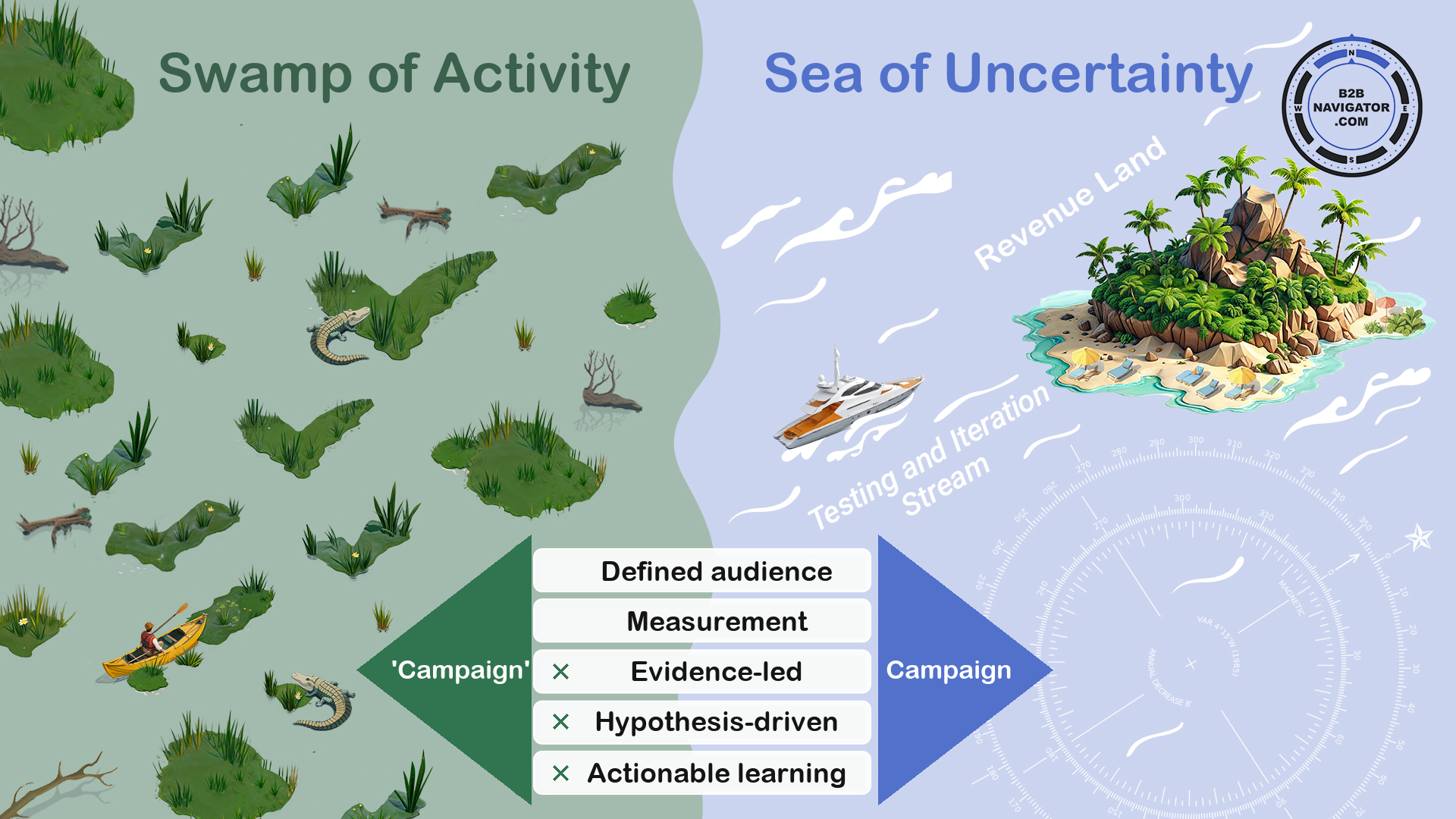
The dingiest part of the MC swamp is conflation with a single tactic, most notoriously, email. Ten years ago, I thought that the words ‘email marketing campaign’ would lose currency and happily become extinct in short order. That has not happened.
I will take a stand and say that the Marketing Campaign needs to exist, but differently to how it is commonly thought of. That perception of the term is, of course, a broad spectrum, and some readers will be well acquainted with the work of analyst firms who study and define these things carefully.
Forrester describes adaptive programmes that respond to ‘real-time’ buying signals, adjust messages and experiences, and coordinate touchpoints across the customer lifecycle. McKinsey writes of a transition from discrete campaigns to continuous growth capabilities that involve insight, creativity, personalisation, orchestration, and optimisation. Whilst the individual case studies these firms provide are invaluable, I don’t find these high-level descriptions helpful.
Before we get to a proposed definition, I should be clear that a core element of it does not only apply to Marketing campaigns – it is an integral part of the function. Moreover, this element should apply right across the revenue team.
That element is reducing uncertainty. Uncertainty is the permanent operating condition of much of B2B marketing, particularly in the early growth stages. Low volumes, long sales cycles, multiple stakeholders, and organisational variance and fluidity all contribute. Marketing must play a leading part in reducing that uncertainty so that founders and leaders can make the best possible decisions.
Why ‘reducing uncertainty’ and not just ‘learning’? There are three reasons I have deliberately chosen this as the centrepiece of my proposal.
First, reduced uncertainty affects a decision. Founders and leaders about to make a bet on an audience, a proposition or something else are open to learning, but what they really want is to be less likely to be wrong. Jordan Ellenberg’s excellent ‘How not to be wrong’ comes to mind here. Secondly, learning doesn’t have a defined bar to clear. We will probably learn something from the lowliest disconnected tactic, but it is unlikely to reduce the uncertainty that is a barrier to growth. Thirdly, ‘uncertainty’ sounds uncomfortable, and gives us a useful jolt. In the world of B2B marketing, which is notorious for self-serving generalities, I think this is helpful.
To make the definition useful, I’ll describe what it is, what it isn’t, and what it should do, noting how the emphasis shifts as a company grows. To bring the definition to life, there is nothing like a bit of contrast, so I’ve added a table comparing a promising modern campaign with its exact opposite. Constructing this proved to be quite a bit of fun.
The Marketing Campaign Defined
I could cite some of the many authoritative definitions of the term that I have read, but it is a favour to the reader, I think, to come straight to my proposal. Since the definition is quite dense, I will start by highlighting the key points as simply as possible.
A B2B marketing campaign is a deliberate intervention that creates commercial value while reducing uncertainty.
There are three elements here – the deliberate intervention, the creation of commercial value, and the reduction of uncertainty.
The deliberate intervention is the defining aspect of the campaign. It commits a defined stake for a specific audience over a declared period and states upfront the conditions that will tell you whether the effort was repaid. This is quite different to a programme that is measured, but runs without an end date or verdict. A verdict has to carry consequences: if the conditions you set are not met, the campaign stops, or you continue it with a different bet.
By commercial value I mean an effect the business would recognise as worth having: demand that did not exist before, a higher win rate, or customers retained. The purposes below pair each of those with the challenge it answers.
Here is the full Marketing Campaign definition in a single sentence.
A marketing campaign is a deliberate, evidence-led, hypothesis-driven and coordinated intervention for a defined audience and business purpose, conducted over an explicit decision horizon to generate measurable commercial outcomes and actionable learning.
This is still only a single sentence, and rather dense, so it needs further expansion. To this end, I’ve described the implication for each of the key words used in the definition.
| Term | Implication |
|---|---|
| Deliberate | The rules of engagement are defined upfront in terms of accountability, agreed rules for spending, data and AI usage. Some people like to call this governance. |
| Evidence-led | Available evidence (however scant) informs and refines the audience, problem, proposition, channel and measurement choices. The gaps in what we know are acknowledged up front. |
| Hypothesis-driven | If this sounds too academic call it a ‘bet’, not a hypothesis, but don’t discard it. Where data and evidence is limited, and it often is in B2B, the campaign must include hypotheses we can test, using market responses to learn and reduce uncertainty. |
| Coordinated intervention | Whatever the activities are, they must work together, and they must specify how attention, understanding or interest progresses into a useful action. |
| Defined audience | The audience is economically and behaviourally bounded. We remain open to evidence that a different or adjacent audience may respond in ways we had not anticipated. |
| Business purpose | The campaign serves a commercial need or learning requirement. Learning should be built into every campaign. |
| Decision horizon | The evaluation period(s) are clearly stated. I say periods because short sprints can be used to prove or disprove particular ‘bets’ whilst a longer overall timeline is used to judge objectives. |
| Measurable commercial outcomes | Measurement examines business effects against a baseline. These are described in more detail, including a note on how the most important outcomes vary by growth stage. |
| Actionable learning | Campaigns should reduce uncertainty in a fashion that can be acted on. |
What a campaign is not
Next, let’s consider those items that could conceivably (or perhaps inconceivably) be confused with a Marketing Campaign, together with the legitimate questions they should ask.
- Strategy: Where will we play, and how will we win?
- Go-to-market motion: How will the company acquire, convert, serve and expand customers in a repeatable fashion?
- Marketing programme: What persistent system should continuously pursue this marketing purpose?
- Journey or buying process: How does the audience recognise, investigate and resolve a need?
- Tactic: What particular action will be taken?
- Marketing Channel: Through what medium or route will the action reach people?
- Technology “campaign” object: How will our CRM or MAP software group activities, audiences and reporting?
What campaigns are for
Having defined what a Marketing Campaign is, and what it is not, let’s now examine what it does. This is essential because our proposed definition uses the term “intervention” to encompass a broad range of purposes beyond lead generation, which is often the unfortunate default. The right-hand column defines the commercial value used in the definition.
| Purpose | Challenge or opportunity | Commercial value created |
|---|---|---|
| Category creation or reframing | Buyers do not recognise the problem or classify it favourably. | Expanded addressable demand and strategic differentiation. |
| Brand and preference building | The company is unknown, indistinct or excluded before evaluation. | Higher consideration, conversion, pricing confidence, and sales productivity. |
| Demand capture | Existing category demand is not reaching the company. | Incremental revenue and more efficient acquisition. |
| Product or market launch | A new offer, segment or geography needs coordinated introduction. | Early revenue, learning, and reference customers. |
| Buyer enablement | Buying groups cannot reach confidence or consensus. | Higher win rates, shorter cycles, and fewer stalled deals. |
| Adoption and value realisation | Customers purchase but underuse the product. | Retention, lower support cost, and readiness to expand. |
| Expansion and advocacy | Existing value is not translating into wider use or recommendation. | Net revenue retention, cross-sell, and referrals. |
| Defence or recovery | Trust, relevance or competitive position has deteriorated. | Reduced churn, protected share, and restored pipeline. |
| Learning | Uncertainty is too high to scale investment. | Better capital allocation and lower go-to-market risk. |
Company Development Stage
The right campaign objective depends on the company’s stage of development, and before putting names to stages, I should say that there is no single definitive model. Summarised in a few words, the leading contenders are: What have you learned (Steve Blank); Can you sell it predictably (Mark Roberge); How do you compare (Bessemer and ICONIQ); and What breaks next (Greiner). There are also funding rounds, of course, which describe investor expectations at a point in time.
If any of those fitted well with the language of the people I work with, I would have happily adopted them. As they don’t, the five stages below are based on the language I hear every day.
- At Discovery, the campaign is gathering information rather than capturing demand.
- At Product-market fit, the campaign is attempting to gather proof that a specific segment buys the product for the same use case, adopts and recommends it.
- At Go-to-market fit, the campaign seeks to prove repeatability in the selling motion, typically with the founder having stepped back from the front line.
- At Scale, the constraint has shifted to channel economics and coordination across products, segments, and lifecycle programmes.
- For the very few that achieve it, Category leadership attempts to defend availability and ‘mental share’ (how readily buyers recall your brand when a need arises).
A promising modern design and its exact opposite
To conclude, I’d like to contrast what I will characterise as a promising, modern design with its exact opposite. This rather enjoyable exercise could easily have run into many dozens of rows, but I have tried to stick to the most salient contrasts.
| Component | Promising modern design | Exact opposite |
|---|---|---|
| Starting point | A diagnosed audience or business condition | An executive requests “a campaign” |
| Audience definition | Based on buying conditions, economics, situations and behaviour | A vague persona based on title and demographics |
| Exclusions | States who will not be targeted and why | More names are inherently better |
| Campaign purpose | A clear business purpose with a primary effect or learning question | Launch completion, content volume or activity count |
| Outcomes and learning | States intended effects and commercial logic. Preserves unexpected or uncomfortable findings | Claims any positive result and suppresses inconvenient learnings |
| Market reach | Sufficient reach across economically relevant buyers | “Precision” targeting that excludes most potential buyers |
| Proposition | A demonstrable promise of audience progress with credible proof | Feature list, slogans and unsupported claims of superiority created by an LLM |
| Message | Stable POV story (at least a set of ideas) adapted as necessary | Separate, inconsistent copy |
| Creative quality | Distinctive, memorable and coherent | Generic, technically competent and indistinguishable AI content |
| Activities | Each activity has a specified role in a causal chain | Marketing channel checklist driven by habit or software availability |
| Buyer experience | Enables independent research, verification, trial and internal sharing | Gates elementary information and immediately triggers aggressive pursuit |
| Buying-group support | Helps participants build consensus | Treats one response as an account-wide buying decision |
| Sales alignment | Shared commercial hypothesis, evidence and account actions | Marketing hands over MQLs; sales complains about quality |
| Product integration | Product, onboarding and service substantiate the campaign promise | Marketing promises an experience the product cannot deliver |
| Account-based marketing | Allocates effort according to account economics and buying complexity | Adds account names to adverts and automated emails |
| Attribution | Used diagnostically alongside experiments, modelling and research | Every touched opportunity is claimed as marketing-created revenue |
| Experimentation and testing | Tests a hypothesis | Runs trivial A/B tests and calls all changes “optimisation” |
| Learning | Audience, creative and causal knowledge are preserved and reused | The campaign ends; files and lessons disappear |
| End state | Valuable elements persist as an audience or lifecycle programme | All activity stops until the next internal launch |
Conclusion
Some companies I have worked for had copious amounts of data about their customers and prospects. At one B2B SaaS company, operating in the Microsoft Office market, we had 5m users in a small geography, and we knew as much as anyone except Microsoft about Office license usage in that country. At a well-established global hardware company, we had large volumes of data on customers’ application performance and system availability, as they delivered it at QBRs. In some startups, we had almost no useful data at the start.
Regardless of the amount of data, there were always high levels of uncertainty about future purchases. Sometimes this was portfolio-driven, often driven by M&A activity – ‘what if we try and sell product A to new audience B’, sometimes due to new product introduction, and sometimes, most intriguingly, in trying to establish a new category.
This is the background to my assertion that a B2B marketing campaign is a deliberate intervention that creates commercial value while reducing uncertainty.
Have I made the case for the lens and definition to stand? Time will tell as I will be inflicting this article on my circle of friends and associates. And you, dear reader, having reached the end of this article, have most definitely earned the right to tell me frankly what you think.
My last word is that any definition of a Marketing campaign should be a sandbox where creativity can frolic. Whilst this article concerns itself with a disciplined, thoughtful approach to campaigning, that discipline must not come at the expense of the magic of creativity. There is no contradiction in this, to my mind: experimentation can be both scientifically grounded and wildly creative, though these virtues don’t often reside in the same person. Where they do, treasure them!