From No Data to a Defensible ICP: Practical Segmentation using Public Data
In pre-seed and seed stage B2B tech startups, creating an Ideal Customer Profile (ICP) is essential. But with limited data, founders and investors may skip segmentation and go straight to the ICP. Without initial segmentation, however, the ICP is unlikely to be as useful as it could be. Basic segmentation work, even if imperfect, is necessary. This article describes an approach to B2B segmentation for startups that will provide the foundations for a usable ICP.
Before going further, note that our method assumes your company’s problem is clear enough to score. Many pre-seed founders are still defining their problem, and segmentation can’t solve that. If direction is unclear, start with “What is a Winning Aspiration and Why Do You Need One?”
Segmentation In Context
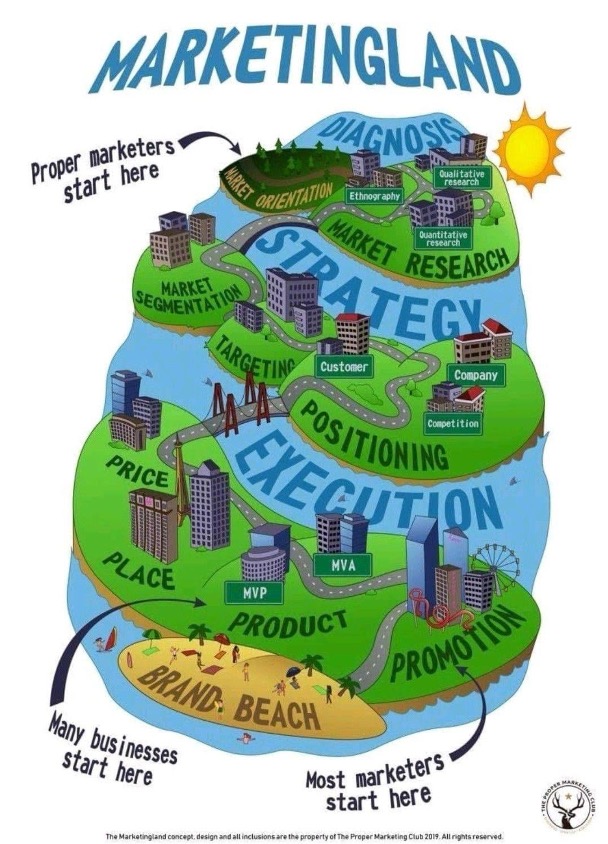
Segmentation sits within the trinity of Segmentation, Targeting and Positioning, on the island of Strategy in the excellent graphic and framework, Marketingland.
The trinity is sequential, but with loops. Segmentation comes first because it maps the terrain: it lays out the available options before any commitment is made.
Targeting follows. Where segmentation maps options, targeting narrows the focus to a specific area worth pursuing. It is an act of commitment, not just analysis: choosing one segment means de-prioritising others.
Positioning is the third element of the trinity, defining how you will be seen by that chosen target relative to the alternatives. It sits outside thescope of this article, which focuses on the foundations — segmentation and the targeting decision that produces an ICP.
The loops matter as much as the sequence. Targeting work often exposes a segmentation cell that was scored too generously, or too harshly, and sends you back to the grid. Positioning work can reveal that the chosen target is too broad to occupy a defensible space, prompting a tighter targeting decision.
Segmentation Using Public Data
The method we will use here has four steps.
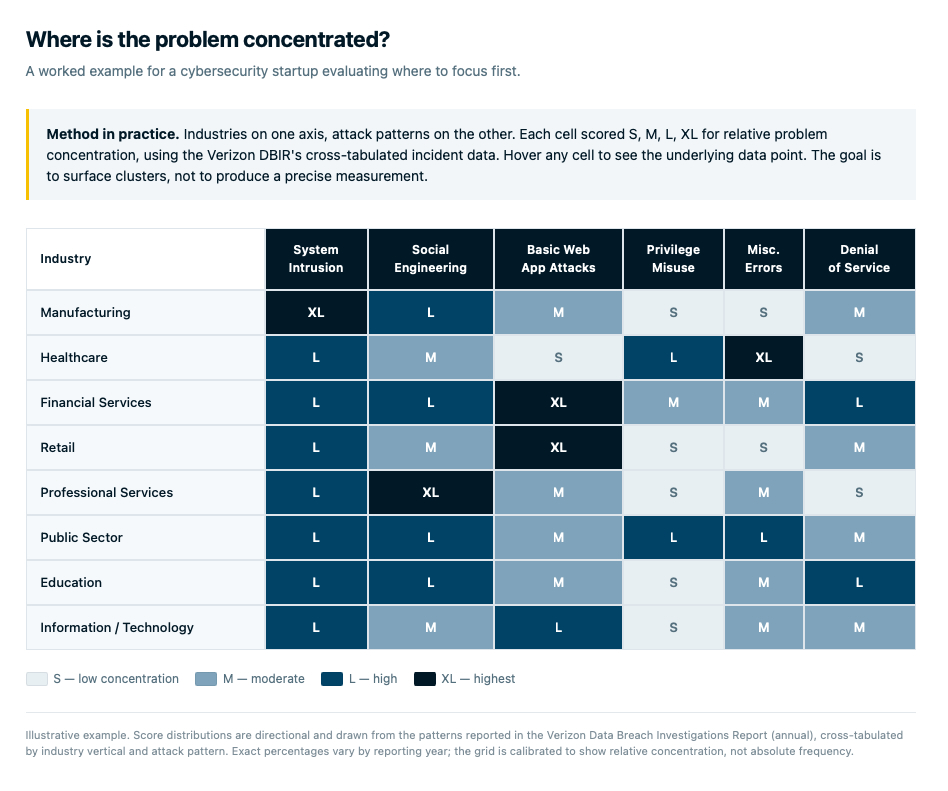
Identify a public data point. This needs to correlate with the intensity of your problem, as the data source you choose shapes the grid that we use to visualise the segmentation. At this stage, directional accuracy, industry coverage, and problem relevance are all you need. Seeking perfection, or anything like it, will undermine the exercise.
Define two axes. Build a grid with industries on one axis and problem subcategories on the other. A spreadsheet works, but HTML is better because you can mouse over cells to show the data source.
Score each cell for relative problem concentration, not precision. Use T-shirt sizes (S, M, L, XL). If you need to justify using T-shirt sizes, clarify that this is a structured starting point, not a final analysis.
Read the grid for concentrations. The grid should reveal XL clusters of pain. These may confirm your expectations or surprise you.
An Example
For example, a cybersecurity startup can use Verizon’s DBIR, a data set cross-tabulated by industry and attack patterns, to score each cell and identify concentrations.
From Segmentation to Targeting
Targeting means committing to a specific part of the grid. That commitment only stands if you have a reasonable chance of winning. The chance of winning depends on both the company’s capabilities and the strength of the competition.
Relative Targeting, from SiriusDecisions (now Forrester), matches market opportunity to your ability to win. It considers both external market factors and your team’s strengths.
In practice, this means building a short checklist across two dimensions.
Market factors (external)
- Trends: Is the purchasing of your type of solution increasing in this vertical?
- Triggers: Are there specific events or circumstances that prompt a buying decision in this space?
- Competitive landscape: Is a key competitor particularly active in one sector and absent in another?
- Economic health: Is one vertical growing faster than the others you’re considering?
- Adoption rate: How quickly are companies in this vertical adopting your category or adjacent categories?
Company capability factors (internal)
- Domain expertise: How much does the team collectively know about this space?
- Advisor and influencer contacts: Who do you know, or could reach, who could get you up to speed quickly?
- Solution fit: Does any aspect of the product design give you a natural advantage in a particular vertical?
- End user contacts: Which verticals have prospects the team can approach directly?
- Channel contacts: Where does the team have existing channel relationships?
Relative Targeting doesn’t require extensive research. Even with limited data, this checklist distinguishes between attractive and achievable segments. For deeper analysis, see How to Prioritise One Audience Over Another.
The Extent of Segmentation Required
At pre-seed, estimate where the problem is most intense and where your team can likely compete. That’s enough to design and test your first ICP.
By Series A, investors will expect more. Closed/won and closed/lost deal analysis will be available by then, possibly accompanied by intent data. That will sharpen or challenge the original segmentation, but that is fine; the grid built here is not meant to last forever – it is just meant to get you started.
From Targeting to ICP
At this point, the ICP earns its place.
The ICP describes the ideal customer within your chosen segment—tailored to your target. Our model for developing multi-dimensional ICPs is the B2BNavigator.com Spider Compass. This extends the ICP beyond the tablestakes of firmographics/technographics into an eight-dimensional model covering fit, propensity, value, and exclusion. For more on why the ICP is harder than most teams expect, see Seven Reasons Building an ICP Is Harder Than You Think.
Solid Foundations for an ICP
This approach to B2B segmentation for startups will not deliver the precision of intent data, which tracks behavioural signals such as content consumption and competitor research to identify companies that are actively evaluating a purchase, or of an analysis built from closed/won, closed/lost deals. What it will deliver is a structured, evidence-based view of where the problem is concentrated, built on public, credible, and available data today. That is a solid foundation for targeting and ICP development.